30-Day
30-Day Standard Pilot
For quick validation on a simple or medium-complexity site.
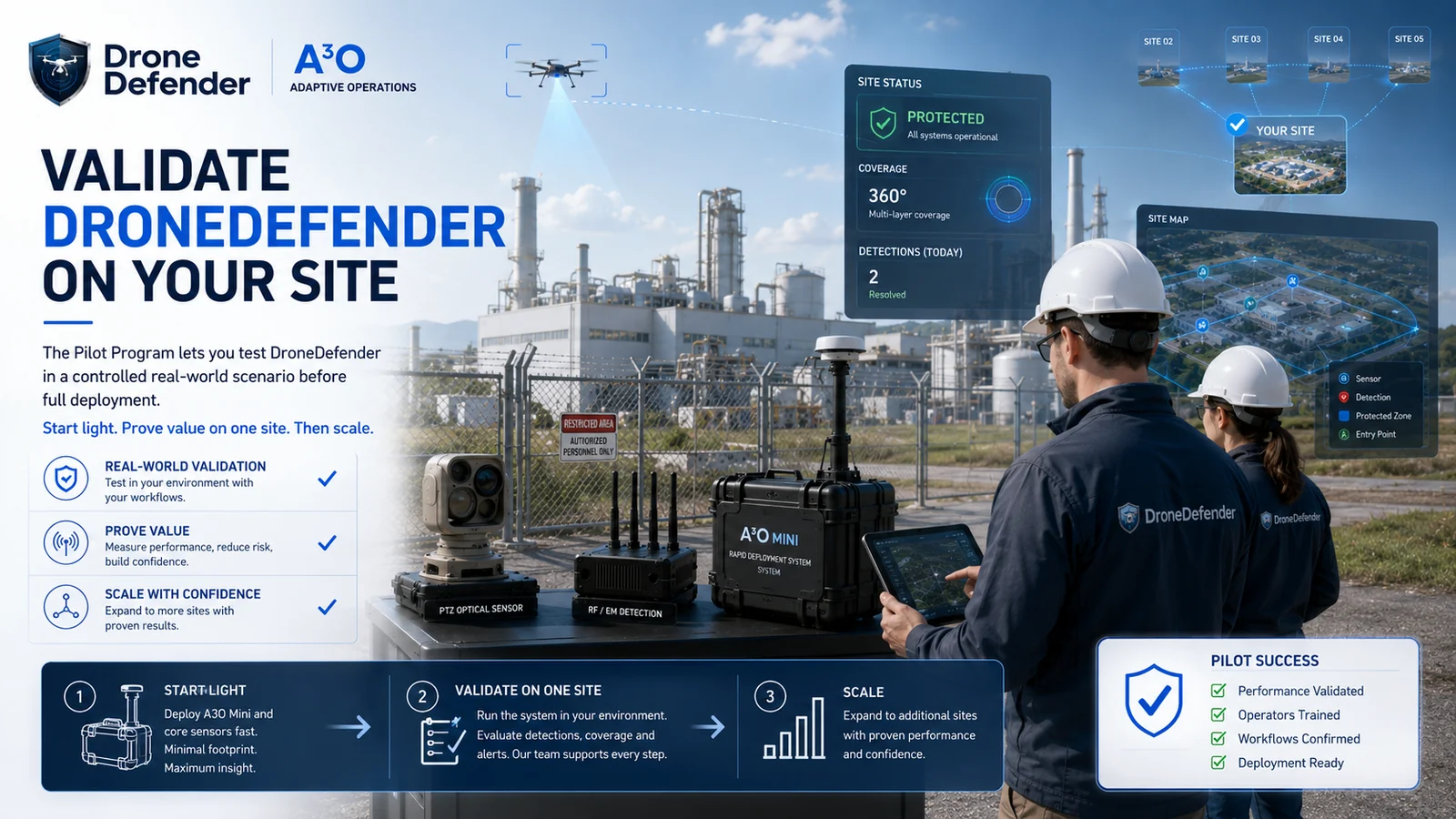
Learn more →The Pilot Program lets you test DroneDefender in a controlled real-world scenario before full deployment — start light, prove value on one site, then scale.
Structured validation before full deployment.
A typical pilot includes a temporary system configuration, software access, a Digital Twin Lite of your site, an operator demonstration with the AI advisor, reporting and a recommended deployment configuration — and can begin on the light online platform in hours.
A pilot must end with a decision-ready report.
For quick validation on a simple or medium-complexity site.
Learn more →For complex sites, integrations and several stakeholders.
Learn more →Risk summary, detected events, operator feedback, recommended configuration and commercial offer.
Learn more →Deployment of a kit on your site, building the digital twin of the facility, connecting your existing cameras, configuring zones and alert thresholds, operator training, and a closing report with real detection statistics.
Typically a few weeks: enough to collect statistics on the real air traffic over the site, tune thresholds to the local environment and filter out false alarms from birds and machinery.
Power and network at the installation points, access for mounting, a security contact person, and — if available — access to existing cameras over RTSP or ONVIF. Internet is not required: the system runs locally.
Yes. Processing happens on site and the video stream never leaves it. At the end of the pilot you receive a report and the event log; what to share beyond that is your decision.
You get a report with the actual figures for your site: how many overflights occurred, which layers triggered, where blind spots remain. The final configuration is priced on that basis — equipment and cost for your specific facility rather than an averaged quote.
Start with a short consultation, live demo or structured pilot program.